Choosing the right training institute can have a major impact on a student’s confidence, practical ability and future career direction. In 2026, education is increasingly moving beyond textbook knowledge toward practical skills, digital fluency, communication, creativity, AI awareness and employability.
This shift is especially important for students in Guwahati and across Northeast India.
The Government of India’s current Skill India Mission focuses on helping young people become future-ready through industry-relevant training, while NITI Aayog’s 2026 skilling report stresses that practical training, hands-on projects, industry exposure and employability skills are essential for better workforce outcomes.
Against this changing educational landscape, PCD Arttech Academy Guwahati is building a distinctive learning model that combines academics, visual arts, performing arts, communication skills, competitive preparation and emerging technology under one platform.
The academy was established in 2024 under Shree Arts and Educational Trust and describes its mission as combining traditional cultural learning with modern technological and practical skill development. Its current official website lists its location at Ganeshguri Chariali, Nayanpur Road, Madan Complex, Dispur, Guwahati.
So, why is PCD Arttech Academy becoming a notable training institute in Guwahati?
1. A Modern Approach to Skill-Based Education
One of the biggest changes happening in education today is the move from qualification-only thinking toward skills-first learning.
India’s latest skilling policy discussions recognise that theoretical education alone may not adequately prepare students for real-world challenges. NITI Aayog’s August 2026 report points specifically to gaps in hands-on training, industry exposure, communication and digital skills, and recommends stronger practical and work-integrated learning.
PCD Arttech Academy’s current learning model aligns well with this direction.
The academy states that its programmes combine:
- Academic learning
- Practical exercises
- Creative exploration
- Individual mentoring
- Skill development
- Career counselling
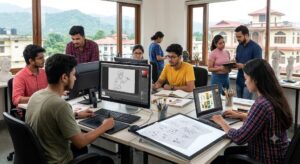
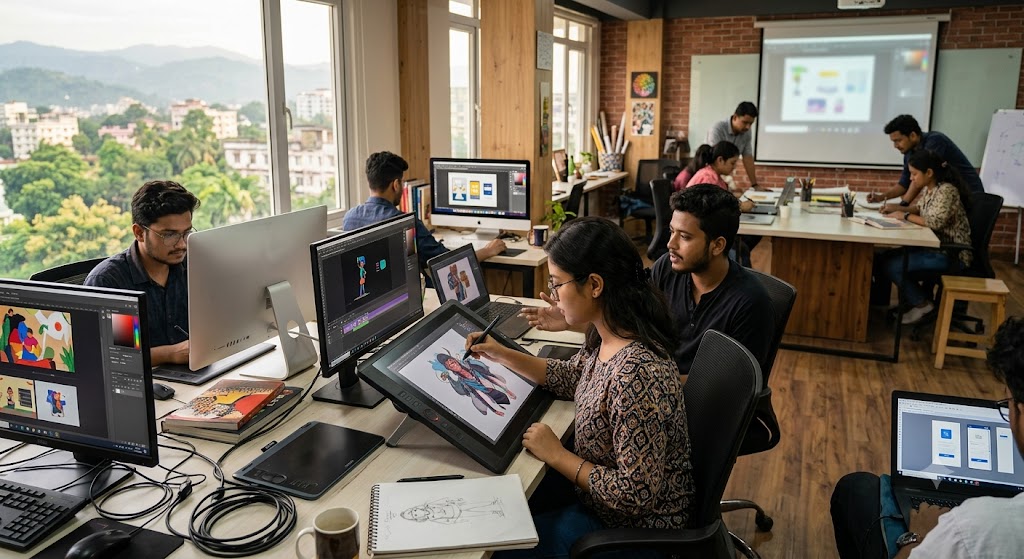
- Hands-on training
- Communication development
- Future-ready learning
Its website specifically identifies hands-on training as one of its core learning features.
This is important because students often understand a subject more effectively when they can apply what they have learned.
2. Academics, Arts and Technology Under One Platform
Many training institutes focus on only one field.
PCD Arttech Academy takes a broader approach by combining several areas of education.
Its current programme categories include:
- Academic Tutorials
- Competitive Crash Courses
- Visual Arts & Craft
- Performing Arts
- Languages & Communication
- Future Tech & AI Skills
This combination makes the academy particularly interesting because a student may develop more than one kind of ability.
For example, a student interested in academics may also want to improve spoken English.
A creative student may want to learn fine arts while developing digital design skills.
Another student may be preparing for entrance examinations while also learning communication and presentation skills.
This multi-disciplinary model reflects a broader change in education: future careers increasingly require combinations of technical, creative and interpersonal skills rather than a single isolated qualification.
3. Focus on Future Tech and AI Skills
Artificial intelligence is transforming education and employment.
The India Skills Report 2026 places digital fluency and AI among major forces reshaping workforce readiness. The report puts India’s overall employability at 56.35% in 2026 and highlights the growing importance of AI and technology-related skills.
The 2026 NIIT India Skills Gap Report similarly identifies AI, cybersecurity, digital and data skills among important future capabilities.
PCD Arttech Academy has responded to this changing environment by including Future Tech & AI Skills among its programme categories. Its official website describes these as programmes bringing together artificial intelligence, design and practical skills.
For students in Guwahati, access to such training can help increase exposure to tools and concepts that are increasingly relevant across industries.
AI knowledge is no longer useful only for software engineers.
Today, AI tools are appearing in:
- Graphic design
- Content creation
- Marketing
- Research
- Office productivity
- Education
- Entrepreneurship
- Photography
- Communication
- Business operations
Learning how to use emerging tools responsibly can therefore become an important part of career preparation.
4. Strong Focus on Visual Arts and Creativity
Technology is important, but creativity remains equally valuable.
PCD Arttech Academy offers training across several forms of visual and applied arts, including:
- Art & Craft
- Resin Art
- Calligraphy
- Graphics
- Sculpture
- Print Making
- Digital Painting
- Thermocol Art
- Poster Making
This variety allows students to explore traditional artistic abilities alongside newer digital forms.
Creative education can also help develop broader skills such as:
- Observation
- Patience
- Problem-solving
- Visual communication
- Original thinking
- Attention to detail
- Presentation
- Confidence
For students who want careers or entrepreneurial opportunities in creative industries, building a strong portfolio of practical work can be particularly useful.
5. Performing Arts Training
PCD Arttech Academy does not restrict creative development to visual arts.
Its current programme structure also includes vocal and instrumental music as well as classical dance forms.
Performing arts education can support skills that extend beyond the stage.
Students may gradually develop:
- Confidence
- Discipline
- Memory
- Coordination
- Stage presence
- Expression
- Communication
- Consistency
This makes performing arts useful both as a specialised interest and as part of broader personality development.
6. Communication and Language Development
Strong technical knowledge can lose value if a person cannot communicate effectively.
Communication is becoming increasingly important in:
- Interviews
- Client meetings
- Presentations
- Entrepreneurship
- Teamwork
- Customer service
- Leadership
NITI Aayog’s 2026 skilling report specifically identifies communication and digital abilities among foundational employability skills that students need for workplace readiness.
PCD Arttech Academy currently includes:
- Spoken English
- Foreign Languages
- Creative Writing
- Public Speaking
within its Languages & Communication programmes.
This can be especially valuable for students who understand their academic subjects well but need greater confidence speaking or presenting themselves.
7. Academic Support for Classes VIII to XII
Not every student joining a training academy is looking only for vocational education.
Some need stronger academic foundations.
PCD Arttech Academy currently offers academic tutorials for Classes VIII to XII across academic streams.
This allows students to continue focusing on school performance while also receiving exposure to creative or practical skills.
The combination can be useful because secondary-school years are often when students begin considering:
- College options
- Entrance examinations
- Professional courses
- Skill development
- Creative careers
- Competitive examinations
Having academic guidance and broader career-oriented exposure in one ecosystem may help students explore their interests earlier.
8. Competitive Exam Preparation
PCD Arttech Academy also currently lists targeted preparation for examinations including:
- SSC
- CEE
- CUET
- NEET
- Other entrance examinations
Exam preparation requires a different learning strategy from general tuition.
Students often need:
- Structured revision
- Practice questions
- Time management
- Mock examinations
- Performance analysis
- Exam strategy
PCD Arttech Academy additionally lists online and offline mock tests among its learning activities.
This gives students opportunities to practise under more realistic examination conditions.
9. Hands-On Learning Instead of Theory Alone
This may be one of the most important advantages of skill-based education.
NITI Aayog’s 2026 research notes that practical training, projects and industry exposure remain limited in many parts of India’s traditional education system. It recommends a stronger focus on applied and work-linked learning.
PCD Arttech Academy specifically promotes practical exercises and hands-on training as part of its educational approach.
This can be particularly useful in subjects such as:
- Fine arts
- Graphic design
- AI tools
- Craft
- Music
- Communication
- Public speaking
- Digital skills
A student learning graphic design, for example, benefits from actually creating designs rather than only learning design theory.
A public-speaking student improves by speaking.
An art student improves by creating.
An AI student improves by experimenting with tools.
Practical learning converts information into ability.
10. Personalised Mentoring
Students do not all learn at the same pace.
Some understand concepts quickly but lack confidence.
Others are creative but need better structure.
Some students require additional practice, while others need guidance in choosing a career direction.
PCD Arttech Academy identifies personalised mentoring as one of its key features, with guidance intended to consider individual learning needs and goals.
This kind of mentoring can help students identify:
- Strengths
- Areas for improvement
- Suitable courses
- Career interests
- Training priorities
- Learning goals
It may also help students avoid choosing courses simply because their friends are taking them.
11. Career Counselling and Placement Support
Training should ideally connect learning with future opportunities.
PCD Arttech Academy currently lists both career counselling and placement support within its wider student-development approach.
It is important to distinguish placement support from guaranteed employment.
A professional institute can help students prepare through guidance, portfolio development, interview preparation and opportunity awareness, but employment ultimately depends on factors such as the student’s performance, skills, vacancies and employer requirements.
This distinction is important for transparent education marketing.
NITI Aayog’s current skilling recommendations similarly emphasise the need to move from enrolment-focused training toward stronger outcome, employment and progression pathways.
12. Entrepreneurship-Oriented Skill Development
Not every student wants a conventional job.
Some want to become:
- Freelancers
- Artists
- Designers
- Trainers
- Content creators
- Small-business owners
- Digital professionals
PCD Arttech Academy says its programmes aim to develop creativity, confidence, communication and entrepreneurship.
This is relevant because many creative and digital skills can potentially be converted into independent work.
For example:
Graphic design → freelance design services
Art → commissioned work or workshops
Digital painting → creative services
Public speaking → training and presentation opportunities
AI tools → productivity or digital-service skills
The goal should not be to promise instant income, but to help learners develop capabilities that can later support employment or entrepreneurship.
13. Learning Beyond the Classroom
PCD Arttech Academy’s current model includes several extracurricular learning opportunities such as:
- Summer and Winter Camps
- Creative Workshops
- Art Exhibitions
- National-Level Competitions
- Annual Cultural Festival
- Expert-Led Masterclasses
- Career Counselling
- Talent Recognition Programmes
- E-Certification Programmes
These activities can help students demonstrate skills instead of only keeping their learning inside notebooks.
An exhibition allows an art student to present work publicly.
A competition helps students test abilities under pressure.
A workshop provides exposure to new techniques.
A cultural programme helps develop stage confidence.
These experiences can contribute to broader personal development.
14. Flexible Learning Options
Students today frequently manage several responsibilities at once.
A school student may have regular classes and tuition.
A college student may be preparing for examinations.
A working learner may only be available during specific hours.
PCD Arttech Academy lists flexible timings among its features, describing schedules intended to accommodate learners with different commitments.
This can make professional training more accessible to students who otherwise struggle to fit skill-development courses into their routine.
15. Accessible Fee Philosophy
Professional training becomes useful only when students can realistically access it.
PCD Arttech Academy states that it aims to maintain affordable fees so learners from different backgrounds can access educational opportunities.
Students should still confirm:
- Current course fees
- Course duration
- Materials cost
- Examination fees
- Certification details
- Refund policies
- Instalment options
before enrolling.
Transparent cost information is an important part of choosing any training institution.
16. Guwahati Is Becoming an Important Skilling Hub
PCD Arttech Academy’s location in Guwahati also matters.
Guwahati is increasingly important in India’s wider skill-development ecosystem.
The National Skill Development Corporation currently lists a Skill India International Centre in Guwahati at IIE Lalmati. NSDC says these centres focus on industry-aligned training, language skills, assessment, certification and workplace readiness.
This does not mean PCD Arttech Academy is affiliated with that centre; rather, it demonstrates the larger importance Guwahati is gaining as a regional destination for skill development.
For students across Assam and Northeast India, access to professional training within Guwahati can reduce the need to travel to larger metropolitan cities for every type of skill programme.
17. A Blend of Traditional Culture and Emerging Technology
One aspect that distinguishes PCD Arttech Academy’s positioning is its attempt to bring traditional creative skills and modern technology together.
Its official mission describes the academy as bridging traditional cultural heritage with forward-looking technological skills.
This approach is particularly relevant in Northeast India.
Students do not necessarily have to choose between preserving creativity and learning technology.
A modern creative professional may combine:
drawing + digital painting
traditional art + graphic design
music + digital media
creative writing + AI tools
craft + entrepreneurship
Technology can become a tool for expanding creativity rather than replacing it.
18. Registered Organisational Structure
According to its official website, PCD Arttech Academy operates under Shree Arts and Educational Trust, established in 2024.
The site currently states that the organisation is:
- Registered under the Indian Trusts Act, 1882
- Registered on NGO-DARPAN
- ISO 9001:2015 certified
and displays NGO-DARPAN ID AS/2025/0572265. These are claims published by the academy itself, so prospective students should verify any registration, accreditation, certificate recognition or affiliation that is important to a particular course before enrolling.
That verification step is especially important when a course is being taken for a specific employment, government or higher-education requirement.
19. What Should Students Check Before Joining a Training Institute?
Even if an institute appears attractive, students should make an informed decision.
Before enrolling, ask:
- What exactly will I learn?
- How much of the training is practical?
- Who will teach the programme?
- What is the duration?
- What are the total fees?
- What certification will I receive?
- Who issues that certificate?
- Is the certificate recognised for my intended purpose?
- Will I create projects or a portfolio?
- Is career guidance available?
- What does placement support actually include?
- Are there demo classes?
- Are classes online, offline or hybrid?
- What are the attendance requirements?
- What happens after course completion?
A good training institute should be able to answer these questions clearly.
20. Why PCD Arttech Academy Stands Out in Guwahati
There is no authoritative citywide government ranking that establishes one private training institute as objectively “the number one” institute in Guwahati.
A more useful way to evaluate PCD Arttech Academy is to examine the features that make it stand out as an emerging multidisciplinary training option.
Its current strengths include:
- Academics and skill development under one platform
- Visual and performing arts
- AI and digital training
- Spoken English and public speaking
- Competitive exam preparation
- Hands-on learning
- Personalised mentoring
- Flexible timings
- Career counselling
- Placement support
- Creative workshops
- Competitions and exhibitions
- Entrepreneurship-oriented development
- Location in Guwahati
These features correspond closely with the direction of India’s broader skilling ecosystem, where practical learning, digital readiness, communication, career guidance and industry relevance are increasingly emphasised.
Who Can Consider PCD Arttech Academy?
PCD Arttech Academy may be worth exploring for:
School Students
Students looking for academic support alongside creative or communication skills.
Competitive Exam Aspirants
Learners preparing for entrance and competitive examinations.
Creative Students
People interested in art, craft, digital painting, calligraphy, music or dance.
Students Interested in AI
Young learners looking for introductory exposure to AI and digital tools.
Job Seekers
Candidates wanting to improve communication and practical skills.
Aspiring Freelancers
Learners interested in creative or digital services.
Entrepreneurs
People who want to develop communication, creative and technology skills for independent work.
The Future Belongs to Multi-Skilled Learners
One of the biggest lessons from India’s changing employment market is that students should not depend on one skill forever.
Technology changes.
Job roles change.
Industries change.
Customer expectations change.
The Government of India’s Skill India Mission is therefore increasingly focused on skilling, reskilling and upskilling so that young people can remain relevant as labour markets evolve.
The India Skills Report 2026 also reflects the growing importance of digital fluency and AI in workforce readiness.
A student who combines academic knowledge with communication, creativity, technology and practical ability may therefore be better prepared for an uncertain future.
That is the broader idea behind PCD Arttech Academy’s multidisciplinary model.
Start Your Learning Journey at PCD Arttech Academy Guwahati
Education is no longer only about completing a syllabus.
Students today need opportunities to learn, practise, create, communicate and adapt.
PCD Arttech Academy Guwahati brings together academic tutorials, competitive preparation, visual arts, performing arts, language development, AI skills and practical learning within one educational platform.
For students and parents searching for a training institute in Guwahati focused on practical skills, creativity and future-ready learning, PCD Arttech Academy offers an approach worth exploring.
Before enrolling, students should review the exact curriculum, faculty, fees, certification and career-support terms applicable to their chosen programme.
The best training institute is ultimately not the one that simply promises the most.
It is the one that helps a learner turn knowledge into practical ability, creativity into confidence and skills into meaningful future opportunities.
Best External Backlinks for Proper SEO
1. Skill India Digital – Government of India
Skill India Digital
2. Ministry of Skill Development & Entrepreneurship – Skill India Mission
Skill India Mission 2026 – PIB
3. NITI Aayog – Reimagining Skilling for Viksit Bharat@2047
NITI Aayog Skilling Report 2026
4. NSDC – Skill India International Centres
Skill India International Centres – NSDC
5. NSDC – Skill Development & Industry Connect
NSDC Industry Connect and Skill Development